
Inside Ruto’s Re-Election Budget: Visible Promises, Hidden Costs to Kenyan Households
As education and national security take the lion share of the budget, fueling suspicions of a re-election-driven fiscal strategy ahead of 2027, amid economic hardship, rising dissent, and fears of tightening political control

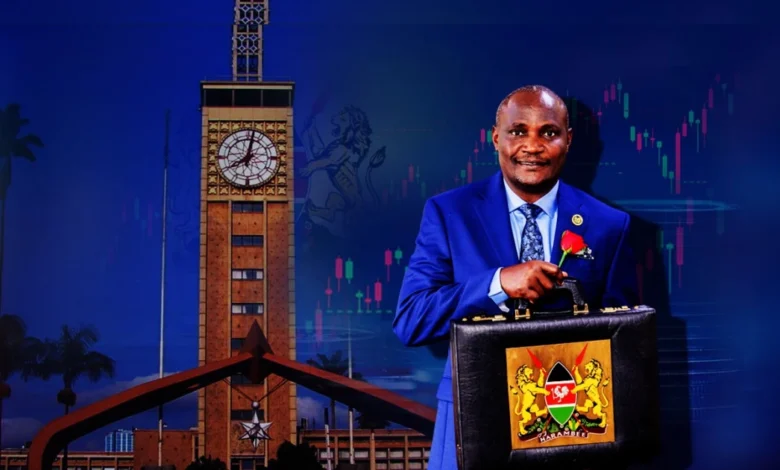
Nairobi, June 15 – Treasury Cabinet Secretary John Mbadi’s Sh4.84 trillion budget for the 2026/27 financial year, presented on Thursday last week, was hailed as a “no new taxes” budget. Coming after three years of unrelenting economic hardship, record-high fuel prices, a public debt burden still above 67 percent of GDP, rising public anger over taxation, and the Gen Z protests of 2024, the framing carried strong political resonance.
A closer scrutiny of CS Mbadi’s proposal reveals a budget that is less about transforming the economy or improving livelihoods and more about political positioning ahead of the 2027 elections. As the final full-year fiscal plan before Kenyans head to the polls in August 2027, it becomes a defining political document, arguably the most consequential in shaping President William Ruto’s re-election bid.
Rarely does a national budget align so precisely with the electoral calendar. The upcoming fiscal year runs until July 2027, ending barely a month before Kenyans go to the polls. For a president seeking re-election, implementation of the budget is not just an administrative exercise but also a critical campaign instrument, perhaps the clearest measure through which the administration’s performance will be judged upon. In this sense, political analysts note that the real weight of the document is not in its design but more in how its promises are translated into visible action in the months leading to the Kenya’s general election in 2027.
Viewed through that lens, the budget’s priorities become easier to understand. At a time when Kenya faces mounting debt, rising living costs, runaway corruption and hundreds of billions of shillings in pending bills, spending in the 2026/27 fiscal year will be concentrated in sectors with immediate public visibility. Roads, housing and education emerge as the clear winners, while politically painful tax measures have largely been avoided.
Buying visibility through spending
Education received Sh 784.5 billion, equivalent to 26.4 percent of total ministerial expenditure and by far the largest allocation in the budget. The figure represents an increase of Sh 81.8 billion from the previous financial year.
The allocation stretches across virtually every level of the education sector. The Teachers Service Commission received Sh 424 billion; university education Sh 127 billion, basic education Sh 142 billion, the Higher Education Loans Board Sh 56.3 billion, university scholarships Sh 30.9 billion and Technical and Vocational Education and Training institutions Sh 30 billion.
The political significance of education spending in Kenya is difficult to ignore. Former President Mwai Kibaki’s promise of free primary education became one of the defining policies of his administration. A decade later, the Jubilee government’s in 2013 pledge to provide digital learning devices to schoolchildren became a powerful campaign message despite failing to deliver on the promise.
With public frustration growing over delayed capitation, university funding challenges and rising education costs, the latest increase appears designed to reconnect the government with millions of parents and young people directly affected by the sector.
Infrastructure spending follows a similar logic. Roads and transport infrastructure were allocated Sh220.4 billion, while housing and work received Sh135 billion. Within this mix, low-volume seal roads, cheaper and faster to roll out in rural constituencies, stand out as particularly strategic, allowing the government to demonstrate visible progress at the grassroots level where electorate are believed to be more gullible.
Unlike many economic reforms whose benefits take years to materialise, roads and housing projects are immediately visible, politically marketable, and capable of generating quick economic activity. They create temporary jobs, stimulate local economies, and offer ready-made ribbon-cutting opportunities that can be repeatedly showcased in a politically charged campaign season.
By comparison, the security sector also received Sh566 billion, making it the second-highest funded sector in the budget, while health receives Sh177.2 billion. The size of the security allocation is likely to draw scrutiny at a time of economic strain and rising public dissent. Critics argue that the spending appears less focused on addressing persistent insecurity, including banditry in parts of the Rift Valley and terrorism threats, and more on strengthening agencies increasingly accused of targeting opposition figures, activists, and Gen Z protesters. Youth, women and equity sector were allocated Sh109 billion, while agriculture received Sh63 billion. In the context of an approaching election, they see it as part of a broader effort to tighten political control and manage dissent ahead of the 2027 polls.
At the same time, the government has been careful to avoid the kind of aggressive tax measures that triggered nationwide protests in 2024 and 2025 respectively. Revenue measures in the budget are projected to raise Sh120 billion, significantly lower than the Sh345 billion targeted in the previous Finance Bill that sparked the demonstrations.
Political analysts note that this shift is telling. The Kenya Kwanza administration came to power criticising large infrastructure projects and debt-fueled development, yet roads, housing, and other flagship projects now sit at the centre of its spending priorities. For critics, this reversal reflects electoral calculations more than an ideological or economic rethink.
The hidden cost of “no new taxes”
The most politically attractive message in the budget 2026/27 is the claim that there are no new taxes. Yet the government’s fiscal position tells a more complicated story. The Sh 4.84 trillion spending plan is supported by projected revenues of Sh 3.631 trillion and grants of Sh 44 billion, leaving a budget deficit of Sh 1.146 trillion that will be financed through borrowing.
To raise additional revenue without introducing highly visible tax increases that could trigger nationwide protests similar to those seen in 2024 and 2025, the government turned to adjustments in the VAT regime. The budget proposes shifting a range of essential goods from zero-rated to VAT-exempt status. While the distinction appears technical, economists argue its effects are far from trivial.
Under zero-rating for instance, businesses can reclaim VAT paid on inputs, ensuring tax costs are not embedded in the final price. Under exemption, that refund mechanism disappears, forcing businesses to absorb additional costs that are eventually passed on to consumers.
The Institute of Public Finance warned when they appeared in Parliament that the changes would increase production costs in sectors such as food production, healthcare and clean energy. Affected products include animal feed, pharmaceutical raw materials, motorcycles, electric buses, solar batteries and lithium-ion batteries.
The Institute of Certified Public Accountants of Kenya also similarly cautioned that exempting animal-feed inputs could significantly increase costs throughout the agricultural value chain.
Healthcare may be among the hardest hit sectors. Dialysis machines and pharmaceutical inputs are among the items being shifted to exempt status. Economists argue that while the changes are presented as tax relief, they are more likely to increase procurement costs and eventually raise healthcare expenses for patients.
In effect, the Mbadi budget avoided politically explosive tax increases while introducing measures that could still raise the cost of living.
 Servicing the past while borrowing the future
The budget also comes as households continue to face a tight economic pressure. Inflation rose to 6.7 percent in May 2026, driven largely by food, transport and energy costs. Food prices increased by 9.4 percent over the previous year, while transport costs rose by 16.5 percent.
Fuel remains one of the biggest drivers of inflation. Despite recent price adjustments, consumers in Nairobi continue to pay more than Sh 214 per litre of petrol and Sh 232 per litre of diesel.
The government has attempted to cushion consumers through subsidies and stabilisation programmes. While these interventions reduce immediate pressure, they also increase fiscal strain and do little to address the structural drivers of inflation.
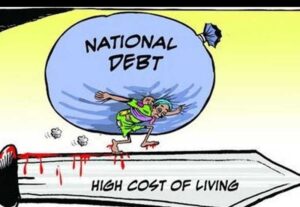
Meanwhile, public debt continues to rise. By March 2026, public debt had reached Sh 12.82 trillion, equivalent to nearly 70 percent of GDP and well above Parliament’s recommended debt anchor of 55 percent. More than 40 percent of government receipts during the first nine months of the financial year went towards servicing debt. At the same time, pending bills stood at Sh 465.87 billion, leaving many suppliers waiting months or years for payment.
The result is a difficult fiscal paradox. The government is increasing spending in highly visible sectors while simultaneously borrowing heavily to service existing obligations.
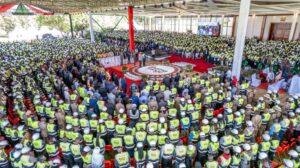
A nation bleeding under a regime fixated on the 2027 re-election
Perhaps the most revealing numbers are found outside the budget itself. The fiscal data increasingly tells a story that sits uneasily beside the government’s rhetoric of austerity and discipline. By March 2026, Article 223 expenditures, withdrawals from the Consolidated Fund intended for urgent and unforeseen needs, had risen to Sh 276.99 billion, nearly six times higher than the previous year.
The Controller of Budget has warned that the growing reliance on such spending raises concerns about budget credibility and parliamentary oversight. Even more striking is how the money is being used. Of the approved Article 223 expenditure, Sh 185.3 billion went to recurrent spending compared to just Sh 19.5 billion for development projects.
State House spending has followed a similar trajectory. Although allocated Sh 8.58 billion for the financial year, expenditure had reached Sh 12.07 billion by March 2026, representing 140 percent of the approved budget. Much of the increase was driven by the Coordination of State House Functions programme, which spent Sh 11.4 billion against an approved allocation of Sh 8.13 billion.
A significant portion of the spending was recorded under the broad category of “other expenses”, limiting public visibility into how the funds were used. To critics, these trends point to a government increasingly reliant on off-budget spending outside normal parliamentary scrutiny and executive discretion at precisely the moment it is preparing for a difficult re-election contest.
Political analysts argue that State House has increasingly evolved beyond its traditional administrative role into a centre of political coordination for Kenya Kwanza. Whether fair or not, that perception is likely to shape how many Kenyans interpret the budget.
They claim that the 2026/27 budget may ultimately be remembered less for its fiscal arithmetic than for what it reveals about a government entering an election year under pressure to retain power, one increasingly inclined toward visible spending, restrained taxation, expanded executive flexibility, and the deferral of difficult choices until after voters have gone to the polls.
