
Gen Z Anniversary: Did Media Practice Conflict-Sensitive Reporting or Power-Sensitive Journalism?
When does journalistic caution, once meant to protect conflict-sensitive reporting, become self-censorship, and what does that mean for truth, power, and accountability ahead of Kenya’s 2027 elections?


Nairobi, June 27 – In a rare spectacle this week on Thursday, Interior Cabinet Secretary Kipchumba Murkomen publicly praised the media for what he described as “professionalism,” marking a notable shift in tone between the government and the press in the coverage of anti-government protests – the first such applause since the Kenya Kwanza administration came into office in September 2022.
Speaking from the steps of Harambee House on June 25, flanked by Inspector General of Police Douglas Kanja, Director of Criminal Investigations Mohamed Amin, and other senior government officials, Murkomen addressed journalists after a tense day marking the second anniversary of the June 25, 2024 nationwide protests. More than 60 young people were killed during those protests, while hundreds of others were injured and arrested. He commended media coverage of the Gen Z anniversary protests as “professional” and “responsible” journalism.
In what several observers described as a “rare spectacle”, he lauded journalists for their “accurate” reporting and even called them “patriotic.” He expressed satisfaction with the way most media houses covered the day’s events, particularly singling out a live NTV reporter whom he said had accurately described police engaging “goons and gangsters” along Thika Road to prevent them from accessing Nairobi’s CBD – terms the government has consistently used for protesters since June 2024.
He however faulted some media houses for the panelists they hosted during the day, urging editors and their managers to vet TV commentators more carefully, arguing that some appeared overly anti-government.
Watching Murkomen’s press briefing, my concern was not whether the praise itself was deserved, but something more fundamental. What exactly did the government find so commendable about the coverage?
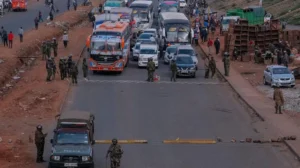
Part of the answer, I suspect, lies in what was emphasised and what was left out in most live coverages. Throughout the week leading to June 25, government officials and allied politicians pushed a highly consistent narrative. Kenyans were repeatedly warned that “goons and criminal gangs” were being ferried into Nairobi by some people whose names were never disclosed, to disrupt order and intimidate businesses. The security response including road barricades, highway screenings, and a heavy police presence in the CBD, was presented therefore as a necessary intervention to restore calm and stability.
Much of the media coverage therefore appeared to follow that framing. The anniversary itself, its constitutional significance, and its place in Kenya’s recent political history often appeared secondary in the day’s news agenda. Instead, reporting leaned heavily toward police maneuvers and the apparent “success” of security agencies in managing the “goons” and other “criminal elements” from accessing the city to “cause chaos.”
Watching the coverage, I could not help but notice that across many television stations, the dominant story was not the protesters and bystanders or the challenges they encountered with police, but the heavy security presence and the operation itself. Roadblocks were consistently described as a “success” in preventing access to the CBD to “cause chaos” (kuzuia waandamanaji kufika katikati ya jiji ili kusababisha vurugu), one reporter described.
This framing was especially clear in a 7pm Swahili bulletin on one of the national television stations, where a single news item dominated the evening news and focused almost entirely on the “success” of the day’s security operation. The reporter described the operation itself in careful, almost “meticulous,” terms as a success, with limited attention given to the broader democratic implications of roadblocks that, for many, effectively curtailed the enjoyment of the right to peaceful assembly as guaranteed under Article 37 of the Constitution.
That framing is what appears to have shaped CS Murkomen’s reaction, with his praise seemingly directed at how many journalists, in their live coverage throughout the day, portrayed those blocked from accessing Nairobi’s CBD as “goons” or “criminal elements,” rather than citizens minding their business or seeking to exercise their constitutional right.
The arrests of 355 people were largely relayed through official statistics, with limited interrogation of legality, conditions, or citizen experience.
For many viewers, the anniversary may have appeared less as a reflection on lives lost in 2024 and the constitutional questions it raises, and more as a successful security operation, and perhaps the narrative the government had sought to project in the run up to the anniversary itself.
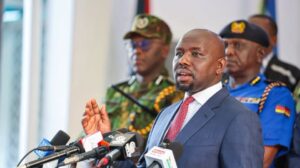 Murkomen himself seemed to reinforce that framing when he concluded: “Today is proof that when demonstrations are conducted in accordance with the provisions of the Constitution, peace and security are guaranteed. This is the political culture we should encourage and promote as a country.”
I found myself wrestling with that conclusion. Like many observers I believe that freedom of assembly was not fully exercised, particularly in Nairobi, where extensive road barricades, restricted access to the CBD, and a heavy police presence that significantly limited movement and participation. If my observation is accurate, then Murkomen’s framing raises an uncomfortable question about whether, in moving forward, roadblocks, containment, and restricted access are becoming the standard approach to managing public dissatisfaction and opposition, justified in the language of constitutional order. And if so, is the media gradually succumbing to the government narrative at the expense of interrogating that contradiction with sufficient rigour?
Security concerns were legitimate. But journalism’s responsibility extends beyond reporting state concerns. It must also interrogate them, contextualise them, and weigh them against other constitutional rights, including the right to peaceful assembly.
From where I sit, I do not think journalists deliberately set out to become government mouthpieces. Most are simply trying to navigate difficult professional choices in an increasingly constrained environment.
But the challenge, I think, is more structural and rooted in the institutional memory of Kenyan journalism itself.
To understand this, one has to return to the echoes of the 2007/08 post-election violence, which left more than 1,000 people dead and placed journalism itself under scrutiny, including accusations of fueling ethnic hatred and the ICC indictment of radio journalist Joshua arap Sang.
The reforms that followed were necessary. Conflict-sensitive reporting became the dominant framework, and journalists were trained to avoid inflammatory language, minimise harm, and consider the consequences of their reporting.
Yet over time, this correction may have produced unintended effects. By 2013, scholars were already noting coverage that “downplayed acts of violence and bordered on self-censorship,” as reporting grew more cautious in its engagement with power. British journalist Michela Wrong captured this dilemma when she wrote that Kenyans were left with “an unsatisfactory choice between the half-truths of the foreign press and the illusions of their own national media.”
 More than a decade later, I am left wondering whether that overcorrection has now become institutionalised, where fear of inflaming conflict has gradually been replaced by fear of appearing destabilising, and whether journalism is becoming more sensitive to power’s concerns than to citizens’ grievances.
I do not pretend to have definitive answers. But what I observed on June 25 raised important questions. Coverage that closely mirrored official framing left me wondering whether parts of our journalism are drifting toward what I might call “power-sensitive journalism,” not because journalists are compromised, but because alignment with authority increasingly feels like the safest professional position.
When barricades are described as a “success” in preventing “goons and criminal elements,” and this framing is repeated across bulletins without equal scrutiny of constitutionality, proportionality, or impact on ordinary citizens, does journalism risk narrowing its field of vision and beginning to see events primarily through the eyes of the state?
Language matters here. In conflict-sensitive reporting, words are never neutral. When citizens are called “activists,” they are seen as exercising rights. When they are labelled “goons” or “gangsters,” they are seen as criminals. When security operations are described as “restoring calm,” they appear legitimate. When described as a “crackdown,” they invite scrutiny.
These are not just stylistic choices in journalism. They shape how the public understands power, protest, legitimacy, and dissent.
Perhaps that is why the government’s sudden praise of media deserves closer attention. The Gen Z protests of 2024 disrupted long-standing assumptions in Kenyan political reporting. They were decentralised, digital, largely leaderless, and deeply distrustful of traditional political elites, and they did not fit familiar political scripts.
When Parliament was stormed, when live bullets were used, and when allegations of abductions emerged, journalists who reported critically did not receive similar praises from the government. Instead, they received sharp condemnation. Many faced pressure, intimidation, threats, and even physical assault.
Two years later, the mood appears different. Government officials are praising coverage as “professional” and “responsible.” The state’s narrative about maintaining order has remained largely consistent. What appears to have changed is the way much of the story is being told.
As the country slowly moves toward the 2027 elections, I think this is a conversation that urgently needs to happen within our newsrooms, journalism schools, and professional associations. When did terms such as “goons” become acceptable journalistic language, and who gets to define them?
At what point does adopting the language of power quietly become adopting the framing of power?
 Whose definition of “success” should define coverage of road barricades – the government’s, or citizens denied access to workplaces, hospitals, businesses, public spaces, and even their constitutional right to assemble?
Is caution gradually becoming our journalistic default setting, and if so, when does caution stop being conflict sensitivity and start becoming self-censorship?
When government praise becomes a marker of “good journalism,” who then gets to define what good journalism looks like?
And perhaps most urgently, what lessons are we carrying forward from 2007, 2013, June 2024, July 2025, and now June 2026 second anniversary as the country approaches yet another highly contested election cycle next year?
I ask these questions not because I have settled answers, but because they feel increasingly unavoidable and deserve honest, uncomfortable reflection.
The shadow of 2007 understandably made Kenyan journalism cautious. The lessons of 2013 reinforced that caution. The pressure on journalists during the Gen Z protests added yet another layer of restraint.
Now, government praise risks introducing something more insidious, and more dangerous: the comfort of approval.
