
President Ruto’s Hague Lawyer Found Guilty of Sexual Misconduct
The ex-ICC lawyer who helped clear President William Ruto’s path to State House now brought down by a sexual misconduct verdict

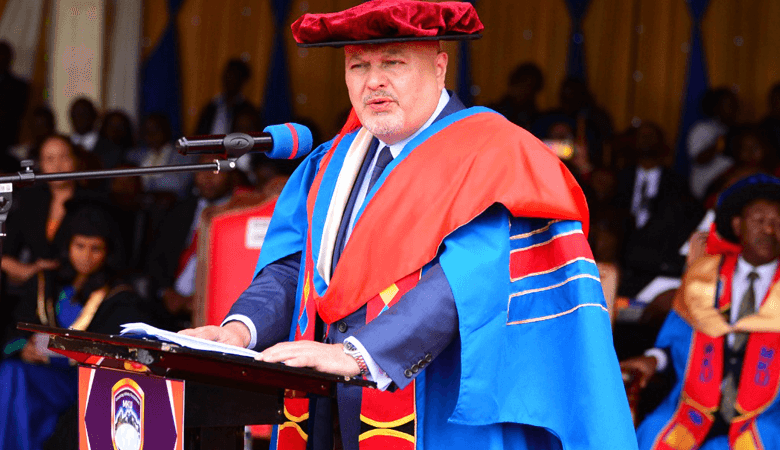
THE HAGUE, July 24 – A decade after helping President William Ruto defeat crimes against humanity charges at the International Criminal Court (ICC), British barrister Karim Khan has become the first chief prosecutor in the court’s history to be removed from office.
In a landmark vote on Friday, the ICC’s 125-member Assembly of States Parties dismissed Khan after concluding that he had committed “serious misconduct and serious breach of duty” over allegations that he sexually harassed and abused a junior female staff member. The decision ends a remarkable legal career that took Khan from defending some of the world’s most controversial figures to leading the world’s only permanent war crimes tribunal – before ending in unprecedented disgrace.
Meeting at the United Nations headquarters in New York, member states voted by secret ballot to remove the 56-year-old prosecutor under Article 46 of the Rome Statute, becoming the first to invoke the provision against a sitting ICC prosecutor. Eighty-two states supported his removal, while 13 voted against and 15 abstained – well above the threshold required to dismiss him from office.
Deputy Prosecutors Nazhat Shameen Khan and Mame Mandiaye Niang, who have overseen the Office of the Prosecutor since Khan stepped aside earlier this year, will continue to lead the institution until a successor is elected.
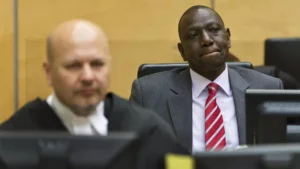 For Kenya, Khan’s downfall carries particular significance.
Long before becoming the ICC’s chief prosecutor in 2021, he built his international reputation in The Hague as lead defence counsel for then Deputy President William Ruto during the post-election violence cases arising from the 2007–08 crisis. His successful argument that prosecutors had failed to present sufficient evidence ultimately led to the collapse of the case against Ruto – then one of the ICC’s highest-profile prosecutions – and cleared the way for Ruto’s eventual rise to the presidency.
That history continued to shadow Khan even after he assumed the court’s highest prosecutorial office.
In August 2023, he travelled to Kenya to receive an honorary Doctor of Laws degree from Mount Kenya University, prompting criticism from opposition leaders who questioned whether his previous role as Ruto’s lawyer created a conflict of interest. Khan later recused himself from all matters relating to Kenya, insisting his visit had been undertaken in a private capacity.
His association with Kenya, however, represented only one chapter in a career that saw him prosecute genocide, war crimes and crimes against humanity while becoming one of international justice’s most recognisable figures.
That career began to unravel in May 2024.
The allegations against Khan first surfaced after a third party reported claims that he had sexually harassed a junior lawyer working in his office. The complainant, a 39-year-old Malaysian lawyer identified publicly only as “Sarah”, later described what she alleged was a sustained pattern of abuse made possible by the extraordinary imbalance of power between the ICC’s chief prosecutor and a subordinate member of staff.
Read more: ICC Prosecutor Karim Khan Under Investigation for Sexual Misconduct Amid Rising Leadership Scrutiny
Speaking publicly for the first time in an interview with CNN, she rejected suggestions that any relationship could have been consensual.
“There is no way for something to be consensual when you have such a power disparity,” she said. “Mr Khan was not just my boss, he was everyone’s boss.”
She alleged that Khan repeatedly subjected her to unwanted sexual advances, describing what she called a gradual erosion of personal boundaries that escalated into more serious acts of sexual abuse. According to documents reviewed by the Associated Press, investigators also examined claims that Khan sought to discourage her from pursuing a formal complaint.
Khan has consistently denied all allegations. In interviews and submissions to investigators, he rejected claims that he had engaged in sexual misconduct, abuse of authority or any inappropriate behaviour.
The road to Friday’s historic vote was neither swift nor straightforward.
An initial inquiry by the ICC’s Independent Oversight Mechanism ended without disciplinary action after the complainant declined to participate and investigators concluded there was insufficient evidence to substantiate the allegations. That outcome drew criticism from observers who questioned whether the court’s internal accountability mechanisms were capable of independently investigating misconduct involving one of its most senior officials.
A second referral in October 2024 dramatically changed the trajectory of the case.
Responsibility shifted to the United Nations Office of Internal Oversight Services (OIOS), which launched a broader investigation into allegations of sexual misconduct and abuse of authority. Over more than a year, investigators gathered thousands of pages of testimony, documentary evidence and witness statements before submitting their findings to a panel of three independent judges tasked with advising the Assembly of States Parties.
That process ultimately culminated in today’s vote, with member states concluding that Khan’s conduct amounted to “serious misconduct” and was incompatible with the standard of “high moral character” required of every ICC prosecutor under the Rome Statute.
Khan’s legal team immediately condemned the decision, arguing that the process was procedurally flawed and unsupported by evidence. In a statement, his lawyers said he would challenge both the lawfulness and fairness of the Assembly’s decision through every available legal avenue, maintaining that investigators had failed to establish the allegations against him.
Khan’s removal comes at a particularly turbulent moment for the ICC, which is confronting mounting political pressure even as it pursues some of the world’s most sensitive cases.
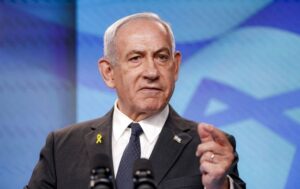
His tenure was defined by a series of high-profile investigations that thrust the court into the centre of global geopolitics. Under his leadership, the ICC issued arrest warrants for Russian President Vladimir Putin over the unlawful deportation of Ukrainian children and, more controversially, sought warrants for Israeli Prime Minister Benjamin Netanyahu and former Defence Minister Yoav Gallant over alleged war crimes and crimes against humanity committed during the conflict in Gaza.
The move against Israeli leaders triggered an unprecedented backlash. The United States condemned the warrants, arguing that the court had overstepped its jurisdiction, and later imposed sanctions on Khan and other ICC officials. The measures included travel restrictions and financial sanctions, highlighting the increasingly hostile environment in which the court operates.
For many observers, Khan’s dismissal therefore comes at a delicate moment. While the decision is rooted in allegations of personal misconduct, it also leaves the ICC without a permanent chief prosecutor as it navigates some of the most politically contentious investigations in its history.
The Assembly of States Parties has stressed that the decision was based solely on the findings of the independent investigation and was necessary to safeguard the court’s integrity and public confidence.
“The standards expected of those entrusted with administering international justice must apply equally to everyone,” Assembly President Päivi Kaukoranta said after the vote, describing accountability within the institution as essential to maintaining its credibility.
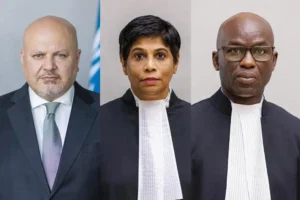
Legal experts say the decision sends a broader message that no official, regardless of rank or prominence, is immune from scrutiny.
“This is an unprecedented moment for international justice,” said Danya Chaikel, International Federation for Human Rights (FIDH) representative to the ICC. “The Assembly has demonstrated that the Court’s leadership is not above accountability. At the same time, member states now face the challenge of ensuring continuity in the prosecutor’s office while preserving confidence in the institution.”
Khan’s lawyers, however, insist the Assembly reached the wrong conclusion. They argue that the process denied him procedural fairness and failed to establish the allegations to the required standard. They have indicated that Khan will challenge the decision through all available legal avenues.
The Assembly is expected to begin the process of selecting a new chief prosecutor in the coming months. Until then, Shameen Khan and Mandiaye Niang will continue overseeing the Office of the Prosecutor, including ongoing investigations spanning Ukraine, Sudan, Palestine, the Democratic Republic of Congo and several other situations before the court.
For Kenya, Khan’s dramatic rise and fall closes an extraordinary chapter in a relationship that has shaped both his career and the country’s place in international criminal justice.
His successful defence of Ruto during the ICC’s Kenya cases transformed him into one of the world’s most sought-after international criminal lawyers. That reputation eventually propelled him to the court’s highest prosecutorial office, where he was entrusted with pursuing accountability for the gravest crimes under international law.
Now, in an extraordinary twist, the man who once helped shape Kenya’s ICC story has himself become part of the court’s history.
His dismissal marks more than the end of an individual career. It is a defining moment for an institution that has long insisted no one is above the law – not presidents, military commanders or rebel leaders. By removing its own chief prosecutor, the ICC has subjected one of its most powerful officials to the same principle of accountability that lies at the heart of its mandate.
