
From Commitments to Impact – Can East Africa Finally Deliver on Its Education Promises?
Beyond Education Promises as East African Leaders Gather in Nairobi to Confront the Challenge of Turning Ambitious Reforms into Better Learning and Future-Ready Skills


NAIROBI, August 27 — East Africa has spent years expanding access to education, developing regional frameworks and promising to equip its young population for a changing economy. But as education ministers, policymakers, teachers, researchers and development partners gather in Nairobi this week, a harder question is taking centre stage on whether those investments are translating into better learning and better opportunities for children?
That is the challenge confronting the 2nd East African Community Regional Conference on Education at the Safari Park Hotel, held under the theme “Transforming Education in East Africa: From Commitments to Impact, Fostering Resilience and Future-Ready Systems for Sustainable Development.”
Across Eastern and Southern Africa, nine out of 10 children aged 10 are unable to read for comprehension, according to UNICEF. The figure exposes the gap between getting children into classrooms and ensuring that they acquire the foundational skills that education systems are designed to provide.
East African governments have expanded access, introduced new curricula, invested in teachers and infrastructure, strengthened technical and vocational education and developed regional mechanisms intended to make qualifications more portable across borders.
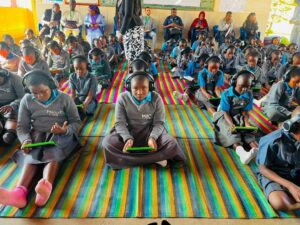
However, access is only the beginning. A child can spend years in school without acquiring basic literacy, numeracy, critical-thinking and problem-solving skills – exposing the distance between being enrolled and actually learning.
That gap was a recurring concern in Nairobi, where delegates were urged to look beyond new curricula, programmes and policy frameworks and consider what those reforms are producing in classrooms.
President William Ruto, who was expected to open the conference on Tuesday, did not appear in person. Instead, Cabinet Secretary for East African Community, ASALs and Regional Development Beatrice Askul Moe, the conference’s Chief Guest, delivered his speech on his behalf. In his remarks, Ruto linked the quality of education directly to East Africa’s economic prospects, arguing that the region’s ability to turn its young population into a productive workforce will depend on what children learn and the skills they carry beyond school.
Ruto’s remarks boiled the debate down to a more uncomfortable question: after all the reforms, investment and promises are our children actually learning?
That question ran through the conference deliberations, with speakers repeatedly returning to learning outcomes as the measure of whether education reforms are delivering what they promise.
A young population, a difficult labour market
The pressure is amplified by East Africa’s demographics. The region has one of the world’s youngest populations, creating the possibility of a powerful demographic dividend if young people acquire the skills and opportunities needed to participate productively in the economy.
But the labour market is not keeping pace. Research by World Data Lab, the Mastercard Foundation and the University of Cape Town’s Development Policy Research Unit projects that 2.3 million people aged 15–35 will find jobs across the region by the end of 2026, with most entering low-paying, low-productivity informal work.
That creates a difficult equation for education systems. They are expected to produce young people who are adaptable, digitally capable and technically skilled, while the economies into which those young people graduate continue to struggle to generate enough productive formal employment.
Education cannot solve that jobs deficit on its own. But the mismatch makes the quality and relevance of education more consequential.
President Ruto’s remarks acknowledged the problem, pointing to skills gaps, weak links between technical and vocational education and industry, and a rapidly growing youth population as mounting pressures on education systems.
The EAC is responding by building a more integrated regional education architecture. Its TVET Qualifications Framework is intended to improve the comparability and recognition of qualifications, support credit transfer and recognition of prior learning, and facilitate greater mobility of skills across the region.
The Community is also advancing the East African Common Higher Education and Research Area, with a focus on harmonisation, innovation, partnerships and mobility.
For a region whose labour market increasingly crosses national borders, those frameworks could make qualifications more useful. But their value will ultimately depend on whether they work beyond the policy documents.
EAC Deputy Secretary-General Andrea Ariik Malueth acknowledged as much, saying the region does not lack policy ambition but must translate commitments into actual change through clear implementation pathways, institutional ownership and measurable results.
 The inequality behind the learning crisis
The learning crisis is also an inequality crisis. A child in a well-equipped urban private school does not enter the competency-based system with the same opportunities as a child in a poorly resourced rural public school. Yet both are expected to navigate the curriculum and eventually compete for many of the same opportunities.
The conference heard that disparity risks turning reforms intended to broaden opportunity into mechanisms that reproduce existing inequalities.
The regional launch of UNESCO’s 2026 Global Education Monitoring Report on access and equity at the Nairobi conference brought that question into sharper focus, with discussions examining progress in expanding access and reducing disparities alongside persistent inequalities, out-of-school populations and the unequal distribution of resources.
But inequality is not shaped by what happens inside schools alone. Increasingly, forces beyond the classroom determine whether children can attend school, remain there and continue learning.
Climate shocks are one of them. UNICEF estimates that climate-related disruptions affected the learning of 130 million children across Eastern and Southern Africa between 2005 and 2024. The damage to education systems was estimated at US$1.3 billion, while lost learning could translate into as much as US$140 billion in future earnings.
For children already facing learning poverty, each disruption can deepen an existing disadvantage. A school damaged by floods, closed because of drought or made unsafe by extreme heat cannot deliver learning, regardless of how well its curriculum is designed.
That is why resilience has emerged in Nairobi not as a separate environmental issue, but as part of the region’s wider struggle over equity and learning.
 The AI question
Technology has brought another layer to the debate. Governments across East Africa are looking to digital learning and artificial intelligence to improve education, but discussions at the conference have also raised a more immediate question: what problem is the technology meant to solve?
A child without reliable electricity or internet access, a trained teacher or strong foundational literacy may gain little from the latest digital tool. Without addressing those underlying gaps, technology could end up reinforcing the inequalities it is intended to overcome.
In his remarks, President Ruto warned that AI was advancing faster than education systems and challenged East Africa to decide whether its young people will merely consume emerging technologies or acquire the skills to develop and own them.
That ambition places a demanding requirement on schools and universities: they must prepare learners for technologies that are changing faster than the systems teaching them.
Paying for impact
Financing emerged as another fault line in the Nairobi discussions. Kenya’s Principal Secretary for Higher Education and Research, Beatrice Inyangala, told delegates that predictable and sustainable financing was essential to keeping education reforms on course, warning that funding constraints could undermine progress.
But the debate also moved beyond how much governments and development partners are spending to what that spending produces.
Classrooms built, teachers recruited, devices distributed and programmes launched are tangible measures of investment. They do not, by themselves, show whether children are learning.
The harder measure was what happens after the money is spent: whether children can read, do basic mathematics, reason, solve problems and apply what they have learned beyond the classroom.
Ruto made a similar case for scrutiny, arguing that increased resources must be matched by greater value for money and that partnerships should be judged by evidence and impact rather than activity alone.
It brings the different strands of the Nairobi discussions back to a common test: investment matters, but its value ultimately has to be visible in the learner.
 What happens after Nairobi?
As the conference enters its final day tomorrow, August 28, attention is turning to what governments and regional institutions will do with the commitments made in Nairobi.
Speakers have repeatedly stressed the need for clearer implementation, stronger accountability and measurable results, with delegates questioning how regional strategies and frameworks can translate into changes those learners and teachers can see in their classrooms.
The discussion has also broadened the definition of success beyond enrolment and investment. Learning outcomes, equity, resilience to climate disruptions, the effective use of technology and the relevance of skills to the labour market have all emerged as measures by which education reforms are likely to be judged.
For EAC officials, the challenge is now to give those commitments a practical path – with clear responsibilities, resources and ways of measuring progress.
